Multi-Species Conservation Program
It's long been said that the Colorado River is the lifeblood of the West. Today, the Colorado River supplies vital water and power resources for more than 20 million people in Arizona, California and Nevada.
Recently, concerns have been raised about the reliability of these water and power resources following the U.S. Fish and Wildlife Service's 1994 designation of critical habitat for four endangered fish species in the Colorado River Basin.
In response, representatives of the three states, along with the various water and power agencies along the lower Colorado, have formed a regional partnership, which is developing a first-of-its kind multi-species conservation program aimed at protecting sensitive, threatened and endangered species of fish, wildlife and their habitat.
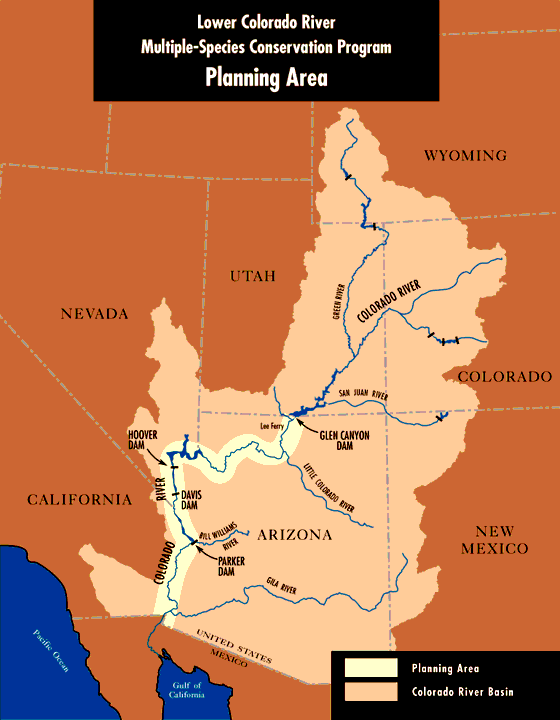
Description:
- • The multi-species conservation
program will work toward the recovery of listed species through habitat
and species conservation, and attempt to reduce the likelihood of additional
species listings under the Endangered Species Act.
- • The proposed long-term program also
will accommodate current water diversions and power production and optimize
opportunities for future water and power development.
- • Planned to be implemented over a
50 year period, the comprehensive program will address future federal agency
consultation needs under the Endangered Species Act's Section 7, and non-federal
agency needs for endangered species incidental take authorization approval
under the Act's Section 10.
- • Over a three-year planning period
for the development of a comprehensive program, interim conservation measures
will be implemented to address the immediate critical needs for certain
endangered species. Interim measures to benefit the endangered razorback
sucker, bonytail chub , humpback chub,
southwestern
willow flycatcher and yuma clapper rail
are proposed during the planning period.
Location:
The program covers the mainstem of the lower Colorado
River from below Glen Canyon Dam to the Southerly International Boundary
with Mexico. The program area includes the 100-year flood plain and reservoir
full-pool elevations.
Biological scope:
More than 100 federal or state-listed, candidate and sensitive
species and their associated habitats, ranging from aquatic, wetland and
riparian habitats, to upland areas will be addressed.
The program will address the biological needs of mammals,
birds, fish, amphibians and reptiles, as well as invertebrates and plants.
Stakeholders:
The program involves
a broad-based state/federal/tribal/private regional partnership, which
includes water, hydroelectric power and wildlife management agencies in
Arizona, California and Nevada. The stakeholders include:
U.S. Department of the Interior:
Fish and Wildlife Service
Bureau of Reclamation
National Park Service
Bureau of Land Management
Bureau of Indian Affairs
Arizona:
Department of Water Resources
Department of Game and Fish
California:
Colorado River Board of California
Department of Fish and Game
Nevada:
Colorado River Commission of Nevada
Nevada Division of Wildlife
Lower Colorado River Basin Indian Tribes:
Hualapai
Colorado River Indian Tribes
Water and hydroelectric power resource management agencies within the three Lower Basin states:
Arizona Power Authority
Central Arizona Project
Coachella Valley Water District
Imperial Irrigation District
Los Angeles Department of Water &
Power
Metropolitan Water District of Southern
California
Nevada Power Company
Overton Power District No. 5
Palo Verde Irrigation District
San Diego County Water Authority
Silver State Power
Southern California Public Power Authority
Southern Nevada Water Authority
Valley Electric Association
Wellton-Mohawk Irrigation District
Conservation and other Non-governmental groups:
Defenders of Wildlife
Southwest Center for Biological Diversity
Program cost:
Projected at about
$4.5 million over three years for planning needs and implementation of
the interim conservation measures. Equitable federal/non-federal cost-sharing
is being pursued.