Gila elegans
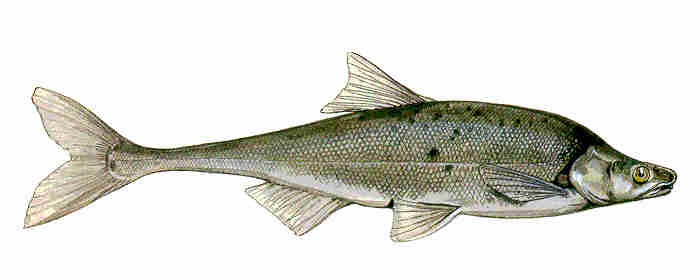
* Silver-gray or dark fish measuring up to 24 inches
long.
* Adults have a streamlined body with a humped back
behind the head, a concave skull, and a terminal mouth(facing down).
* Fins are large and dusky with yellow color near
bases; dorsal fin-rays greater than 10, anal fin-rays usually 10.
* Breeding males have bright red-orange lateral slashes
between paired fins and small tubercles on head and front of body.
* Breeding colors in females are more subdued.
Distribution/Range:
* Historically widely distributed throughout the Colorado
River system, including the Green and Yampa rivers in Utah, Colorado, and
Wyoming and the Gila River in central Arizona and its main tributaries,
the Salt and Verde rivers.
* Currently found only in a few isolated populations
of the Yampa, Green, and Colorado rivers.
* In Arizona, only 1 small population exists in Lake
Mohave on the Colorado River and possibly some individuals further downstream.
Habitat:
* Utilize the mainstream portions of mid-sized to
large rivers, usually over mud or rocks.
* Occupy inundated terrestrial habitats during spring
flooding.
* In reservoirs, they occupy a variety of habitats,
but seem to prefer open areas.
Food Habits:
* In rivers, adults eat terrestrial insects, plant
debris, and algae, while young eat aquatic insects.
* In lakes, they feed on algae and plankton.
Breeding Habits:
* In Lake Mohave, spawning has been observed in May.
* In the upper Green River, spawning occurs in June
and July.
* Eggs are scattered over the bottom; no parental
care occurs.
Reasons for Concern-Listed Endangered:
* Most known populations are made up of older individuals
(40+ years); cold water released below dams prevents successful hatching
of eggs.
* Further habitat loss and modifications caused by
dams and water diversions.