
Lower Colorado River
Multi-Species Conservation Program
It’s long been said that the Colorado River is the lifeblood of the West.Today, the Colorado River supplies vital water and power resources for more than 20 million people in Arizona, California and Nevada. Recently, concerns have been raised about the reliability of these water and power resources following the U.S. Fish and Wildlife Service’s 1994 designation of critical habitat for four endangered fish species in the Colorado River Basin.In response, representatives of the three states, along with various stakeholders and water and power agencies along the lower Colorado, have formed a regional partnership, which is developing a first-of-its kind multi-species conservation program aimed at protecting sensitive, threatened and endangered species of fish, wildlife and their habitat.The partnership has formed a 27-member steering committee, which has been designated by the U.S. Fish and Wildlife Service as an Ecosystem Conservation and Recovery Implementation Team under the federal Endangered Species Act.The steering committee has retained a facilitator and technical consultants to help develop the conservation plan.
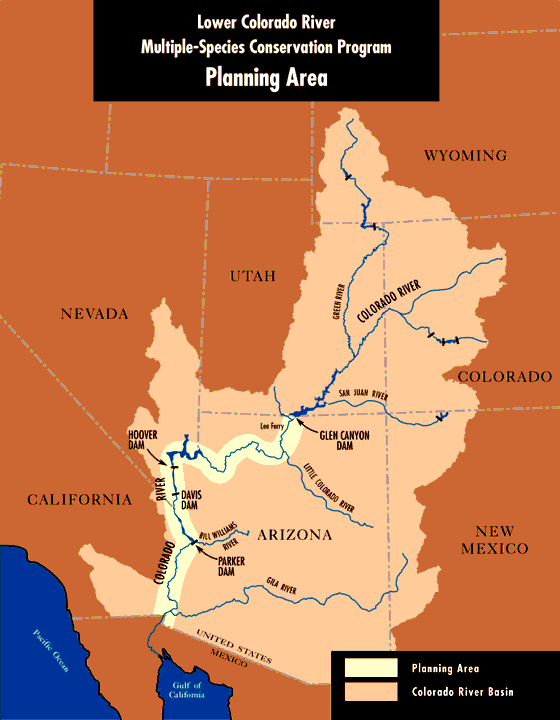
Description:
• The multi-species conservation program will work toward the recovery of listed species through habitat and species conservation, and attempt to reduce the likelihood of additional species listings under the Endangered Species Act.
• The proposed long-term program also will accommodate current water diversions and power production and optimize opportunities for future water and power development.
• Planned to be implemented over a 50 year period, the comprehensive program will address future federal agency consultation needs under the Endangered Species Act's Section 7, and non-federal agency needs for endangered species incidental take authorization approval under the Act's Section 10.
• Over a three- to five-year
planning period for the development of a comprehensive program, interim
conservation measures will be implemented to address the immediate critical
needs for certain endangered species. Interim measures to benefit the
endangered razorback
sucker, bonytail
chub , southwestern
willow flycatcher and yuma clapper rail were initiated in the first three years and will continue
until the Plan is completed and implementation is initiated.
Location:
The program covers the mainstem of the lower
Colorado River from below Glen Canyon Dam to the Southerly International
Boundary with Mexico. The program area includes the 100-year flood plain and
reservoir full-pool elevations.
Biological scope:
More than 100 federal or state-listed,
candidate and sensitive species and their associated habitats, ranging from
aquatic, wetland and riparian habitats, to upland areas will be addressed.
The program will address the biological needs
of mammals, birds, fish, amphibians and reptiles, as well as invertebrates and
plants.
Stakeholders:
The program involves a broad-based
state/federal/tribal/private regional partnership, which includes water,
hydroelectric power and wildlife management agencies in Arizona, California and
Nevada. The stakeholders include:
U.S. Department of the Interior:
Fish and Wildlife Service
Bureau of Reclamation
National Park Service
Bureau of Land Management
Bureau of Indian Affairs
Arizona:
Department of Water
Resources
Department of Game and Fish
California:
Colorado River Board of
California
Department of Fish and Game
Nevada:
Colorado River Commission
of Nevada
Nevada Division of Wildlife
Lower Colorado River Basin Indian Tribes:
Hualapai
Colorado River Indian Tribes
Cocopah Tribe
Water and hydroelectric power resource management agencies within the three Lower Basin states:
Arizona Power Authority
Central Arizona Project
Coachella Valley Water
District
Imperial Irrigation District
Los Angeles Department of
Water & Power
Metropolitan Water District
of Southern California
Nevada Power Company
Overton Power District No. 5
Palo Verde Irrigation
District
San Diego County Water
Authority
Silver State Power
Southern California Public
Power Authority
Southern Nevada Water
Authority
Valley Electric Association
Wellton-Mohawk Irrigation
District
Western Area Power
Association
Other Public Interests
Trout Unlimited/B.A.S.S.
City of Needles, CA.
City of Yuma, AZ.
Quadstate County Government
Coalition
Program cost:
Program
development costs are projected at about $6.7 million over three to five years
for planning needs and implementation of the interim conservation
measures.A federal/non-federal
cost-sharing agreement is in place for the development of the program and the
implementation of interim conservation measures.