SOUTHWESTERN WILLOW
FLYCATCHER
Empidonax traillii extimus
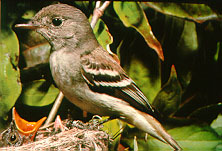
DESCRIPTION:
Small, usually a little less than 6 inches in length, including tail.
Conspicuous light-colored wingbars. Lacks the conspicuous pale eye-ring of many
similar Empidonax species. Overall, body brownish-olive to gray-green above.
Throat whitish, breast pale olive, and belly yellowish. Bill relatively large;
lower mandible completely pale. Best identified by vocalizations. Call a
liquid, sharply whistled whit! or a dry sprrit; song a sneezy witch-pew or
fitz-bew. While perched, characteristically flicks tail slightly upward. Listen to the SW Willow Flycatcher's call. (Requires .mp3
player.) (90k file takes 20-30 secs. to load)
DISTRIBUTION:
The wintering range of E. t.
extimus is uncertain, but the species is known to winter from West Coast of
central Mexico to northern South America. The breeding
range of extimus includes Arizona, California, Nevada, New Mexico, Texas
and Utah. Extimus breeds very locally along the Colorado River and its
tributaries. Many of the breeding sites are occupied by five or fewer pairs.
HABITAT:
The flycatcher breeds
principally in (at low elevations) dense willow, cottonwood, and tamarisk
thickets and woodland along streams and rivers, and (at high elevations) pure,
streamside stands of Geyer willow. Migrants may occur more widely.
BIOLOGY:
Spring arrival in the Lower
Colorado is in late April; fall migration begins as the breeding season ends in
July-August. Males sing repeatedly from exposed perches while on the breeding
grounds, and occasionally during migration. The nest is built of shredded bark,
cattail tufts, and grasses, and lined with fine grasses and feathers. Usually
it is placed in a branch fork in a willow, near water. The eggs are buff with
dark spots at one end. The typical clutch of three (sometimes four) eggs is
laid in May-June. Incubation lasts 12 to 13 days; nestlings fledge after 12 to
14 days. Predation and brown-headed cowbird egg-parasitism may heavily affect
breeding success.
STATUS:
Extensive population reductions
since the 1800s have been inferred from comparison of historical to current
occurrences. They appear to have been caused by habitat loss (conversion or
destruction of native riparian habitats), with nest predation and brown-headed
cowbird parasitism as additional threats. It is also considered endangered in
California and New Mexico. Much smaller populations exist in Nevada, Utah,
Colorado, and Texas. The southwestern willow flycatcher is federally listed as
endangered.
MANAGEMENT NEEDS:
The most urgent needs are: a better understanding of habitat requirements; public-private partnerships that focus on protection of existing willow-cottonwood thickets, and restoration where such habitats have already been destroyed along rivers and streams; continuation of ongoing statewide surveys and monitoring coordinated by Arizona Game and Fish through Arizona Partners in Flight, a group of agency and nongovernmental organizations working together for nongame landbird conservation; and research into the relationship of nest predation and cowbird parasitism to willow flycatcher breeding success.