Xyrauchen texanus
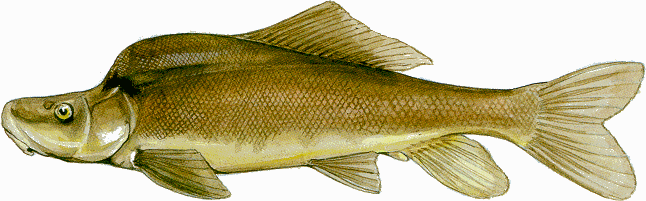
Description:
* Relatively large fish, 29-34 inches long, with an elongated body and head, and a sharp-edged hump rising behind the head in adults.
* Dorsal fin-rays number 14-15; anal fin-rays number 7.
* Males develop coarse, sharp tubercles on anal, caudal, and pelvic fins, which are used to hold females during spawning.
* Coloration for both sexes is olive to brown-black above, brown or pink on the sides, and white to yellow on the belly.
* Breeding males become black or brown above and develop an orange side-band and a bright yellow belly.
Distribution/Range:
* Historically found throughout medium to large rivers of the Colorado River basin, from Wyoming and Colorado to Baja California, including the Gila River basin in central Arizona.
* Current populations in Arizona are limited primarily to Lakes Mead, Mohave, and Havasu on the lower Colorado River.
Habitat:
* In rivers, prefers depths greater than 3 feet in silt- to rock-bottomed backwaters, near strong currents, or in mainstem pools.
* In medium to large reservoirs, prefers deep pools, often up to 50 feet deep.
Food Habits:
* Omnivorous; feeds on algae, larvae, plankton, and detritus.
Breeding Habits:
* Breeding occurs in late winter to early summer and occurs over gravelly bottoms in the mainstream or at the confluence of rivers.
* Females breed repeatedly with numerous males. (Listen to the razorback mating call) (Requires mp3 player)
* Eggs are transparent, adhesive, and are deposited in spaces between the gravel.
* Young hatch in a few days and move to the shoreline for a time.
Reasons for Concern-Listed Endangered:
* Existing populations are made up of only old individuals, some greater than40 years of age, due to a lack of recruitment of young fish into populations.
* Despite successful reproduction, nonnative fishes eat larvae before reaching adulthood.
* Dewatering of rivers and predation by nonnative fishes are still major concerns.