YUMA CLAPPER RAIL
Rallus longirostris yumanensis
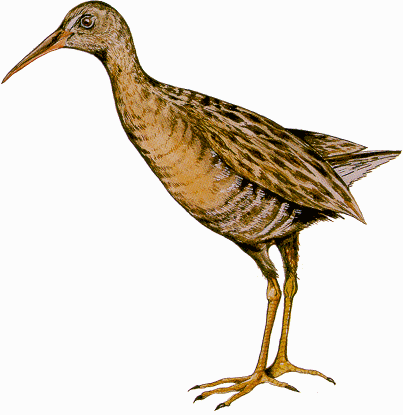 Mary Hirsch
Description:
* Marsh bird with
a short tail, long legs, a downcurved beak, and short rounded wings.
* Males 8 to 9 inches tall, females slightly smaller.
* Subdued burnt-orange breast and orangish beak.
* Flanks and underside dark gray with narrow, vertical white
stripes producing a barred effect.
* Distinctive call a series of ten or more dry
"kek-kek-kek" notes. Listen to the Yuma Clapper
Rail call.(Requires .mp3 player) File takes 15-20 secs. to load.
* Track differs from other shorebirds by showing the
Rearward-pointed hind toe in addition to the 3 forward-pointed toes.
Distribution/Range:
* Western Arizona along Colorado
River from Topock Marsh (part of the Havasu National Wildlife Refuge Near
Needles, California), south to Gulf of California in Mexico.
* Includes lower Bill Williams and Gila River drainages.
* Also Salton Sea (CA), Picacho Reservoir south of Phoenix,
and at the Salt River/Verde River confluence east of Phoenix.
Habitat:
* Freshwater and
brackish (mixed fresh and salt-water) marshes.
* Prefer dense cattails, bulrushes, and other aquatic
vegetation.
Food
Habits:
* Introduced crayfish have become common food.
* Also feed on fish, frogs, clams, spiders, grasshoppers,
crickets, dragonflies, aquatic plant seeds, bird eggs, and crustaceans.
Breeding Habits:
* Establish breeding territories
around March-April and builds nests in nearby vegetation; highly territorial
during breeding.
* Average clutch size 6 to 8 eggs, yellow-buff to green-buff,
irregularly blotched or spotted with brown.
* Incubation lasts about 23 days; eggs hatch April through
July.
* Precocial (active and mobile) young follow adults through
the marsh within 48 hours of hatching; chicks retain black natal down through
first month.
Reasons for Concern-Listed Endangered:
*
Primarily human-related modifications of wetland habitat, such as
channelization, bank stabilization, and water impoundments.
* Prey base, including crayfish, vulnerable to pesticide and
heavy metal poisoning.